
The assessment: radiograph, CT scan and treatment plan
Before anything is touched we need to know how much bone you have, what quality it is and where the structures we must avoid are running: the inferior alveolar nerve below, the maxillary sinus above. A panoramic radiograph gives a first impression, but the decision is made on a dental CT scan, which shows the volume in three dimensions. Both are taken at Centre Mèdic Palafrugell, part of the same group.
At the same appointment we check the condition of your gums and remaining teeth. If there is periodontitis or active decay, that is treated first: an implant placed in a mouth with infection carries a far higher risk of trouble later. With all of that on the table we explain the plan, the number of implants, the expected timings and a written quote.
Placing the implant
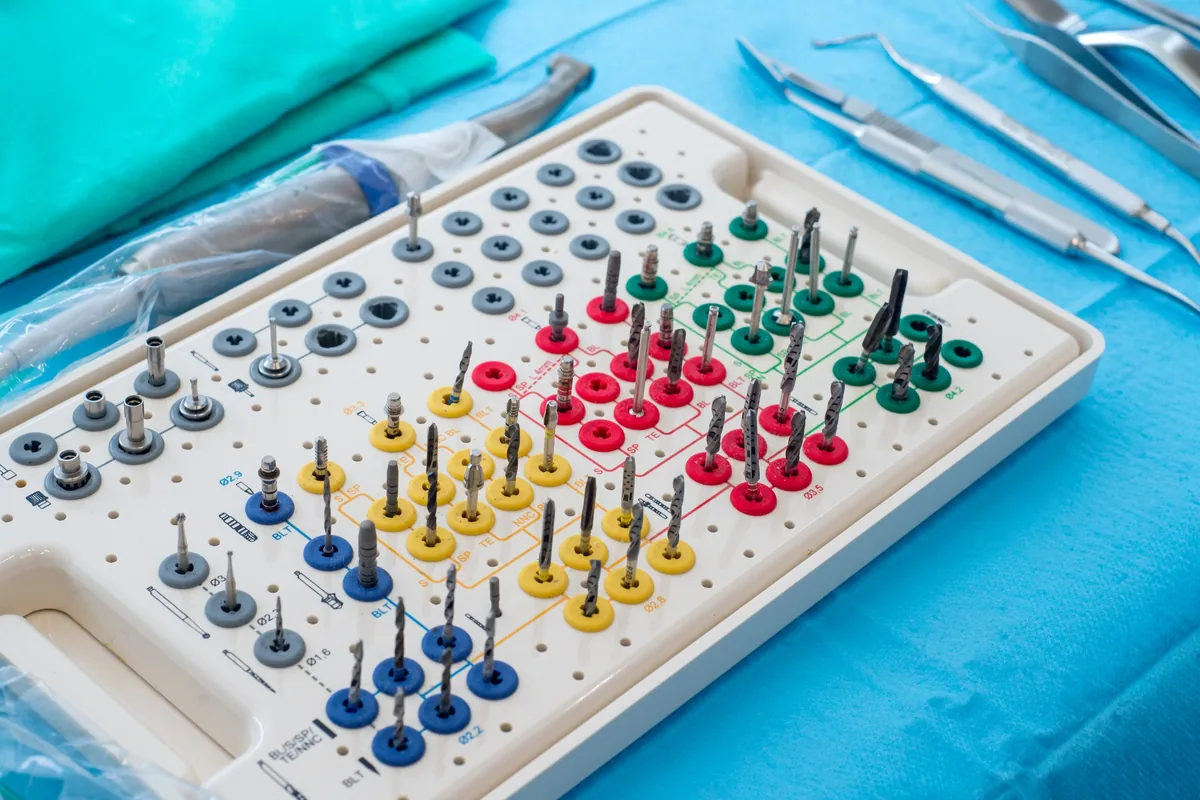
This is a procedure of roughly thirty to sixty minutes per implant, under local anaesthetic. A small window is opened in the gum, the site is prepared in the bone with calibrated drills, and the titanium screw is placed. One or two stitches close it up. You walk out of the practice unaided and can go about normal life the next day, with a few precautions.
For the first two or three days you may notice swelling and some discomfort, both well controlled with the anti-inflammatory we prescribe and a cold pack on day one. Eat soft, cool food, avoid smoking, and do not brush directly over the wound — clean the area with the mouthwash we recommend. Stitches come out after a week to ten days.
Osseointegration and, where needed, bone grafting
Osseointegration is the period during which bone grows onto and locks into the titanium surface. It usually takes 2 to 4 months in the lower jaw and 4 to 6 months in the upper jaw, where the bone tends to be more spongy. It cannot be rushed — it is biology. Meanwhile, if the missing tooth shows when you smile, you wear a temporary so there is never a visible gap.
If the scan shows the ridge is too narrow or too short, the bone has to be rebuilt. This is done with your own bone or a bone substitute, covered by a membrane that stops the gum growing into the space while new bone forms. Small defects are grafted at the same time as the implant; for larger ones, or when the sinus has to be lifted, grafting comes first and adds a few months.
The crown: the part you can see
Once the implant has integrated, a short second visit uncovers it and fits a healing abutment, which shapes the gum around it. A couple of weeks later we take a scan or impression and the laboratory makes the crown, usually in zirconia, matching the shade to your neighbouring teeth.
The crown is either screwed or cemented onto the abutment. At the fitting we check the contact points with the adjacent teeth and, above all, how it meets the opposing teeth: an implant has no periodontal ligament and does not warn you the way a natural tooth does, so getting the bite right is a critical part of the job.
Looking after it, and how long it lasts
An implant cannot decay, but the tissue around it will become inflamed if plaque builds up. That is peri-implantitis, and it is the main reason implants are lost in the long run. With daily hygiene and regular check-ups, a well-placed implant can serve you for many years.
- Brush twice a day, including the inner surface of the crown.
- Use interdental brushes or a water flosser daily around the implant.
- Professional cleaning every 6 months, or every 4 if you have had gum disease.
- Stop smoking: tobacco sharply increases the risk of failure.
- A night guard if you clench or grind.
Come in and we will look at your case
Every mouth has different bone, gums and bite, and the number of months and appointments follows from that. Call 972 30 65 64 or write to us through the contact form for a first appointment: we will explain what your case needs and give you a detailed quote, with the timings for each stage.
Questions about this topic
Does having an implant placed hurt?
Not during the procedure, which is done under local anaesthetic. Afterwards you may have swelling and discomfort for two or three days, similar to an extraction, and both are well managed with the anti-inflammatory we prescribe and a cold pack on the first day.
How long will I be without a tooth?
If the tooth shows when you smile, you will not be: a temporary is fitted from day one. What takes time is what happens below the gum — osseointegration — which usually runs between 2 and 6 months depending on the site and the quality of the bone.
Am I too old for an implant?
Age on its own is not a contraindication; plenty of patients in their eighties have implants without any trouble. What matters is the bone available, the health of your gums, smoking, and any conditions or medication that could affect healing.
Would you like us to take a look? Call us on 972 30 65 64 or write to us using the contact form.