
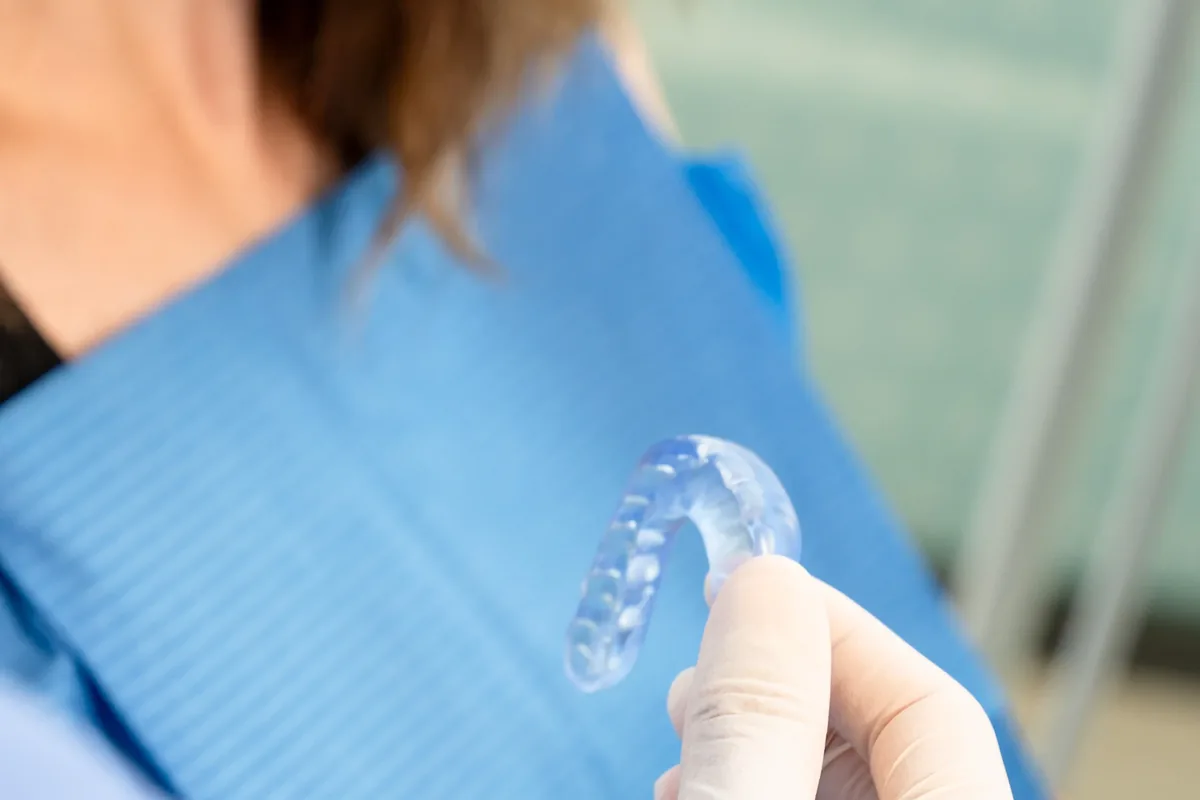
What clear aligners actually are
An aligner is a thin, rigid plastic tray made to fit your mouth from a digital scan. Each tray is designed to move one or two teeth by a few tenths of a millimetre; when you swap it for the next one, the movement carries on. The full set of trays is, in effect, the whole journey your teeth will make from today until the day you finish.
To rotate a tooth, or bring it up or down, the orthodontist bonds small tooth-coloured composite bumps called attachments, which give the tray something to push against. They are barely noticeable and come off at the end. Sometimes a minimal amount of polishing between teeth is also needed to create the small amount of space required, avoiding an extraction.
Who they suit
Clear aligners now handle most of the cases that used to need fixed braces: crowding, gaps, crossbites, open bites, deep bites and — very often — teeth that have drifted back years after an earlier course of treatment. They are also a sensible first step before restorative work: putting teeth in the right position before crowns or veneers means far less enamel has to be touched.
- Adults who would rather not show metal at the front.
- Teenagers whose adult teeth have all come through.
- Relapse after orthodontics done years ago.
- Groundwork before implants, crowns or veneers.
- People who tend to build up plaque around fixed brackets.
The process, from assessment to final tray
It starts with an appointment where we check your teeth and gums, take radiographs and a digital scan of your mouth. If there is decay or the gums are inflamed, we deal with that first — teeth are not moved through unhealthy ground. With that information the orthodontist plans every movement and can show you a simulation of how the bite will end up.
If you are happy with the plan, the aligners are ordered. On the fitting day the attachments are bonded, we check the tray seats properly, and you begin. From then on you come in every six to ten weeks so we can confirm the teeth are tracking as planned and hand you the next batch of trays.
Living with the trays day to day
One rule decides the result: 20 to 22 hours a day. You take them out to eat and to brush, and put them straight back in. For the first day or two of each new tray you will feel pressure and some tenderness when biting; that is normal and means the tooth is moving. Changing trays in the evening lets you sleep through the least comfortable hours.
- With the trays in, drink water only.
- Always brush before putting them back.
- Clean them with cool water and a soft brush, never hot water.
- Keep them in their case — paper napkins are where most trays are lost.
- Carry your previous tray in case one cracks.
And fixed braces? When they are still the better choice
Some cases are more predictable with brackets: severe bite discrepancies, badly tipped or impacted teeth, movements that need a sustained force a tray cannot deliver on its own. They are also a reasonable choice if you suspect you will struggle to wear aligners for the hours required, since fixed braces do not rely on your discipline.
Either way, treatment usually runs from around 6 months in straightforward cases to 18 or 24 months in complex ones. And either way it ends the same: retention. A fine wire bonded behind the front teeth, a night-time retainer, or both. Without retention, teeth tend to drift back towards where they started.
Let us look at your case
Knowing whether aligners will work for you needs an examination and radiographs; it cannot be decided over the phone or from a photograph. Book a first appointment on 972 30 65 64 or through the contact form and we will go through it with your own case in front of us. The cost depends on complexity, and you get a written quote after the assessment.
Questions about this topic
Will people notice the aligners when I speak?
Barely. They are thin and clear, and from a normal distance they are hard to spot. For the first few days a slight lisp on some sounds is common, particularly on an s, but the tongue adapts within a week or so.
Can I have aligner treatment if I have crowns or implants?
In many cases, yes. A crowned tooth moves much like a natural one, although attachments are bonded to it using a different technique. Implants do not move: they are planned as fixed points and the remaining teeth are arranged around them.
What should I do if I lose or break a tray?
Call us the same day. Depending on where you are in the sequence, we will either ask you to go back to the previous tray or move on to the next one while a replacement is ordered. What you should not do is spend days wearing nothing.
Would you like us to take a look? Call us on 972 30 65 64 or write to us using the contact form.